When Real Estate Drone Panorama Photos Beat Standard Stills
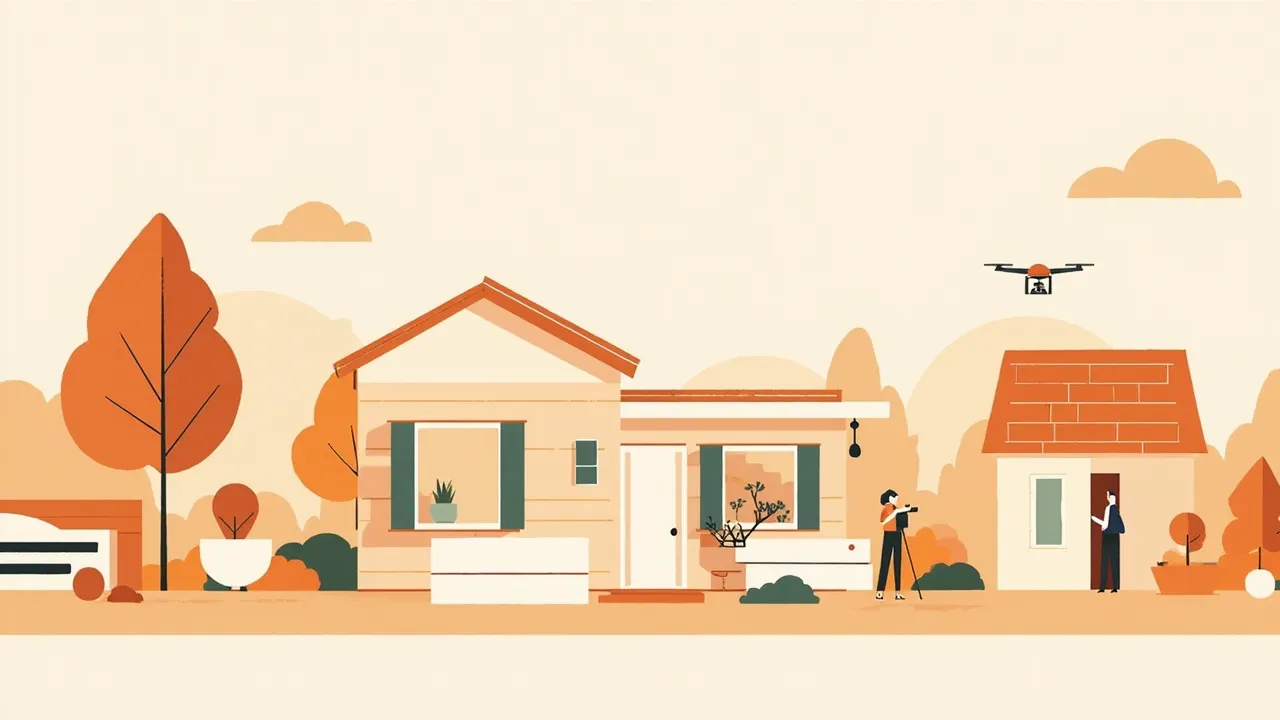
You are checking a listing on your phone, and the first aerial image stretches from the driveway to the far edge of the lot. For a moment, the house, yard, and street finally click into place. That is when real estate drone panorama photos can do something separate drone stills usually cannot.
A stitched panorama combines overlapping drone views into one wide image. Standard stills are often better for showing the front elevation, roof shape, and a clean sense of depth. The panorama is better for explaining the property's footprint and how the land connects to its surroundings.
When a panorama says more
Think of it as a map that still feels like a photograph. It becomes useful when a buyer may struggle to understand the lot from inside the home or from the curb.
- Long or irregular lots where the boundaries are not obvious.
- Properties set far back from the street or spread across several structures.
- Homes where the relationship between the house, driveway, yard, and neighboring land matters.
Standard stills win when the property is compact and its shape is obvious. They also work better for close aerial details, because a wide panorama can make a small feature too distant to read. Use the image that answers the buyer's actual question.
What makes a panorama readable
Most weak stitched images fail because the source views did not line up cleanly. The result may have a crooked horizon, mismatched brightness, or repeated edges that make the property look strangely stretched.
- Keep the horizon level. A tilted flight path becomes a tilted panorama, and it can make the ground look steeper than it is.
- Match exposure and color. Bright sky beside a dark yard creates a visible band.
- Blend overlaps carefully. Trees, rooflines, and pavement lines can double when they land near a seam.
- Choose one clear visual route. A panorama that tries to include every direction loses its shape.
- Leave breathing room around the property. Cropping too tightly at the edge makes the scene feel cramped.
The stitching matters, but so does the original flight. A level, consistent sequence will look natural. If the result feels warped or busy, a standard aerial may communicate the property better.
Where it belongs in the gallery
Lead with the image buyers understand fastest. That is usually a straight-on exterior or the clearest aerial still. Place the panorama after it, where it can answer the bigger question about the lot.
- Check the panorama in the MLS preview, on a phone, and in a social post. Some platforms crop wide images differently.
- Keep the strongest detail shots nearby. The panorama gives context; the standard images give scale.
- Name the story in your notes to the photographer: show the whole property, explain the long approach, or make the lot boundaries clear.
Do not use a panorama to hide a weak first photo. It is supporting context, not a substitute for a clean opening image.
A check you can do this week
This week, open your three newest listing galleries on a phone and ask one question: Can I understand the shape of the property in a single view? If the answer is no, ask for a standard aerial that establishes the house and a stitched panorama only if it adds information the still cannot.
For your next shoot, write one sentence: 'The buyer needs to understand ____.' Give that note to your photographer before the flight plan is set.